
The world of Search Engine Optimization (SEO) is in a constant state of flux. What worked a few years ago might be outdated today, and what’s effective now could be obsolete tomorrow. The rise of artificial intelligence, new search features, and a stronger focus on user experience are fundamentally changing the game. To remain competitive and visible online, businesses must adapt their strategies.
This article explores the key trends shaping the future of SEO, providing actionable insights and real-world examples to help you navigate the evolving digital landscape.
1. The Rise of AI-Powered Search: Beyond Keywords
For years, SEO was a game of keywords. The goal was to find the perfect keyword, write content around it, and build backlinks to rank. Today, search engines, particularly Google, use AI and machine learning to understand the intent and context behind a user’s query. This is known as semantic search.
Google’s Search Generative Experience (SGE) is a prime example of this shift. Instead of a list of blue links, SGE provides a conversational, AI-generated summary at the top of the search results page.
- What this means for your business: Your content must be more than just a collection of keywords. It needs to provide comprehensive, nuanced answers that satisfy the user’s entire query. You should focus on creating detailed content that addresses a topic from multiple angles, anticipating follow-up questions a user might have.
- Real-world example: Instead of a blog post titled “Best Digital Cameras,” a business should create a guide like “The Ultimate Guide to Choosing Your First Digital Camera,” which covers different camera types, sensor sizes, and scenarios (vlogging, landscape photography, etc.). This type of content is more likely to be used in an AI-generated summary because it thoroughly answers the user’s unstated needs.
2. E-E-A-T: The Core of Trust
What is E-E-A-T in SEO?
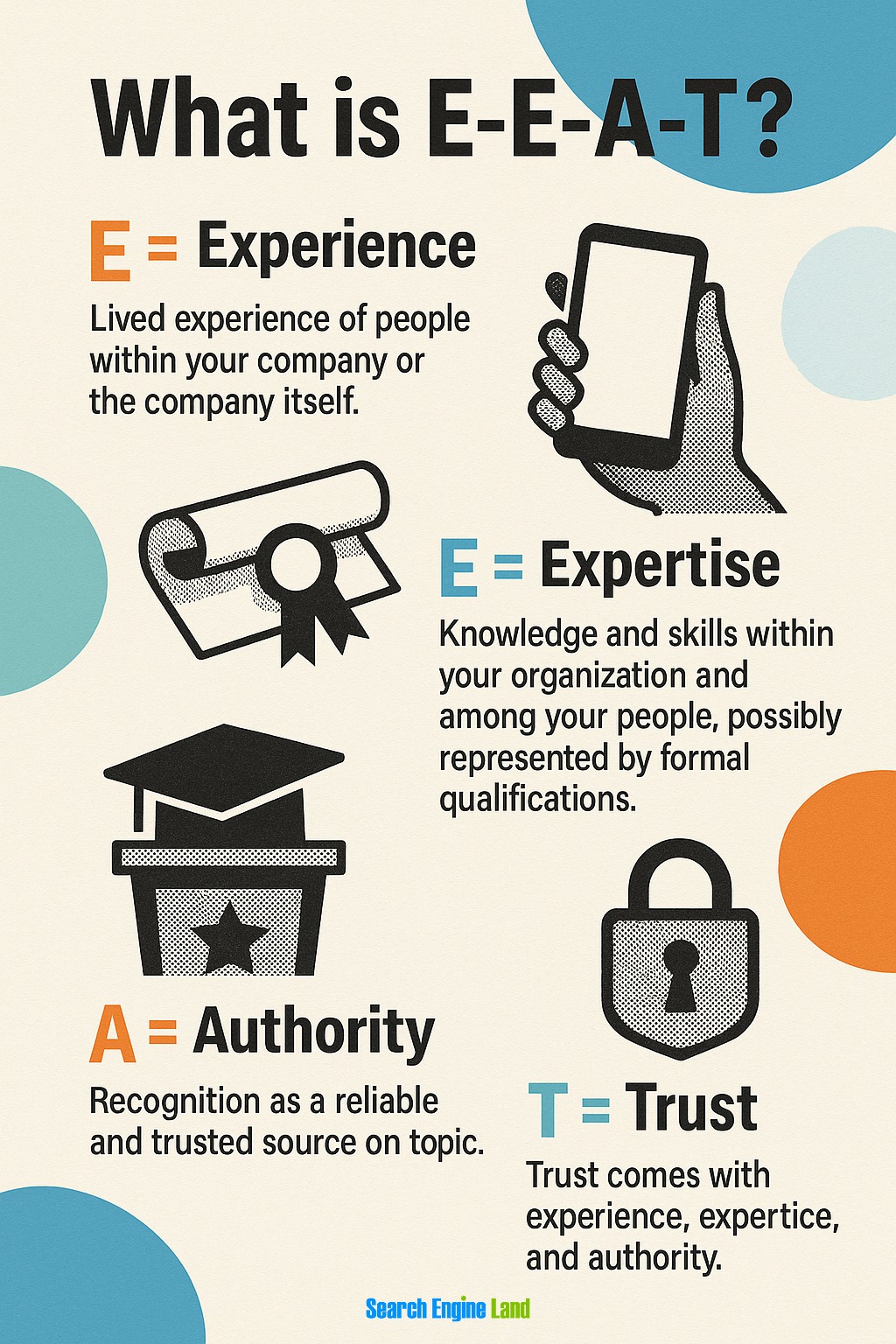
Google’s emphasis on E-E-A-T (Experience, Expertise, Authoritativeness, and Trustworthiness) has never been more critical. This framework is what Google’s Quality Raters use to evaluate content, especially for “Your Money or Your Life” (YMYL) topics like finance, health, and law. The addition of “Experience” a few years ago highlighted the importance of real-world knowledge.
- What this means for your business: You need to prove that you are a credible source of information. This goes beyond just having an “About Us” page.
- Experience: Show that the author has firsthand experience with the topic. For a product review, include a video of the author using the product.
- Expertise: Feature content written by verified experts in your field. A blog about tax law should be written or reviewed by a certified public accountant (CPA).
- Authoritativeness: Build your reputation online. Get mentions and backlinks from authoritative sources.
- Trustworthiness: Ensure your website is secure (HTTPS), your contact information is clear, and your content is accurate and transparent.
- Real-world example: The health website Healthline is a fantastic example of E-E-A-T in action. Every article is written by a professional writer and medically reviewed by a credentialed expert, with the reviewer’s name and credentials clearly displayed. This transparent process signals to both users and Google that the content is trustworthy.
3. User Experience is a Ranking Factor
SEO is no longer just about optimising for search engines; it’s about optimising for people. Google’s Core Web Vitals measure key aspects of user experience, including loading speed, interactivity, and visual stability. A slow or difficult-to-use website will lose not only customers but also a significant amount of its SEO potential.
- What this means for your business: A fast and seamless user experience (UX) is non-negotiable.
- Loading Speed: Optimize images, leverage browser caching, and use a Content Delivery Network (CDN).
- Mobile-First: Ensure your website is perfectly responsive on all devices, as Google uses the mobile version of your site for indexing and ranking.
- Visual Stability: Prevent unexpected layout shifts that frustrate users (e.g., when a button moves just as a user is about to click it).
- Real-world example: A travel company’s website that takes too long to load on a mobile device may see a high bounce rate. Even if the content is great, a user will likely go back to the search results and find a faster competitor. This negative user signal can harm your rankings over time. You can check your site’s performance using tools like Google’s PageSpeed Insights.
A Holistic Approach is the Only Way Forward
The future of SEO is not about outsmarting an algorithm; it’s about providing the most helpful and trustworthy experience for the end-user. The trends of AI-powered search, E-E-A-T, and a focus on UX all point to the same conclusion: success in SEO requires a holistic strategy.
To stay ahead, businesses must:
- Prioritize intent over keywords. Answer the deep-seated questions your audience is asking.
- Demonstrate credibility. Show your expertise and build a reputation as a trusted authority.
- Optimize for a flawless user experience. A fast, mobile-friendly, and easy-to-use website is a fundamental ranking requirement.
By embracing these principles, you will not only improve your search rankings but also build a more valuable and sustainable online presence.
Further Reading: